
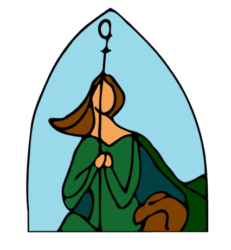
“This is my Son, the Beloved, with whom I am well pleased.” From today’s Gospel, Matthew 3:13-17.
“My suitcase has no clothes but I packed all my hopes in.” Paddington Bear.
This is the First Sunday of Epiphany, when Jesus’ divinity is revealed in baptism at the River Jordan following his revelation to the Gentiles as well as the Jews through the visit of the Magi. He comes to his second cousin, John, who is attracting large crowds partly because of his similarities with the prophet Elijah – both of them spent time in the wilderness and wore simple clothing such as John’s camel hair robe with a leather belt. Each of them was also outspoken and caused offence, John calling the religious leaders a brood of vipers, and both were committed to their preaching. The Gospel of John suggests that John the Baptist was thought possibly to be Elijah, whose return was anticipated by Jews to announce the arrival of the Messiah, or that he was even the Messiah. For those reasons many were flocking to him and John’s own words that he is not worthy even to carry the sandals of the one who is coming are a further manifestation, pointing not to his own but Jesus’ significance.
His baptism is the first time Jesus appears as an adult and all four Gospels mention it, although only Matthew records the conversation between John and Jesus. Thanks to the care of his family and the many unknown others who supported them, Jesus has survived a difficult childhood involving exile in Egypt for two years after Herod’s threats to have him killed and the family has moved to Galilee rather than return to Judea where it’s still dangerous for them. Up to half of children in those days died before they were ten due to violence, poverty, malnutrition and disease so, being a carpenter, it’s likely that Jesus had become a strong and healthy man. This first public act is therefore important when the two men meet in this way as Jesus presents himself for baptism.
At first, John protests about this, suggesting that he should be baptised by Jesus, but Jesus is insistent, telling him “Let it be so now. For it is proper for us in this way to fulfil all righteousness.” Jesus seems to suggest that, for God’s purposes, this is something they should both do together – whatever reservations John may understandably have are then overcome and the dialogue ends with his consent. John may be struggling with what is happening, but he trusts what Jesus is asking of him and the two men are united as the baptism then takes place.
As it does, words are heard announcing Jesus as God’s beloved son with whom he is well pleased and the Holy Spirit is seen descending on Jesus Iike a dove. So often in Bible stories the presence of God is implied or discussed but, at the baptism of Jesus, the Trinity of Father, Son and Holy Spirit together is revealed, and not just the identity of Jesus. God is also us.
Jesus’ followers in every generation are also us,beingcommissionedin Matthew 28:19 to go and baptise all nations, continuing what he has begun. Today, the world can be dark and perplexing, just as it was in the time of Jesus. Then as now, there is also much to bring joy and hope, if that is sought – or brought with us, as Paddington Bear suggests! Perhaps for each of us, as for John the Baptist, there comes a point when, despite misgivings or uncertainty, we also have to accept what God is revealing to us even if it seems unlikely. Matthew writes of John, after his enlightening conversation with Jesus which enables him to see more clearly, ‘Then he consented.’
Do we?
With my prayers; pob bendith,
Christine, Priest Guardian.