
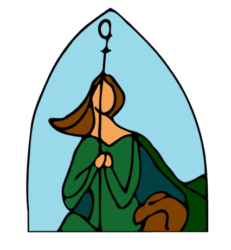
“I am the good shepherd.” Jesus, in today’s Gospel John 10: 1-11a.
“The Lord IS my shepherd. Not was, not may be, nor will be… IS my shepherd.”
Hudson Taylor, Christian missionary to China.
Today is Good Shepherd Sunday, a time when prayers are said particularly for those exercising and considering ministry in the church as a pastor, the Latin word for a shepherd. Here at St Melangell’s, the crockets or ornamental parts at the front of the shrine have often been likened to the ears of sheep, which is so appropriate in this valley which is full of sheep and their lambs.
Amongst them is the small flock of my neighbour, Mary, who owns a cade (bottle fed) sheep called Lambie. She was the second of twins, rejected by her mother after a painful birth, and had to be raised in the house with Mary’s dogs to survive. To this day, Lambie loves dog biscuits as well as sheep food!
This year, Mary thought there would be no lambs as she hadn’t put the sheep to the ram. However, to her very great surprise, her flock has grown from 10 sheep to 23 as 13 lambs have now been born with more still to come. Somehow, rams must have got in – although none were seen.
So it is in the Gospel for today, where Jesus likens himself to being a gate protecting the sheep from furtive intruders and he goes on to call himself the Good Shepherd. In those days, the shepherd himself would lie down across the sheepfold to keep his flock safe from wild animals, bandits and thieves as sheep rustling was common – as it still is today with entire flocks sometimes being stolen or even killed and fleeced in the field for their meat. Then, the shepherd would know and name his sheep as they were usually kept for wool and milk rather than meat and so would be with him for a long time. The sheep would learn to trust the voice of their shepherd who tended his flock and kept them safe whereas hired hands would probably flee for their own safety if thieves came.
The image of the shepherd is used throughout the Bible: Moses was tending sheep when he saw the burning bush; today’s psalm, the 23rd, was written by David, a shepherd boy before he became king; the prophet Ezekiel writes of the shepherds of Israel and their destructive leadership; and Isaiah 53:6 says that All we like sheep have gone astray; we have all turned to our own way. That’s reflected in the words of Cranmer’s General Confession in the Book of Common Prayer of 1552: We have erred and strayed from your ways like lost sheep, we have followed too much the devices and desires of our own hearts.
Jesusdescribed the Temple as a den of thieves when he drove out the moneychangers and one of his disciples, Judas, was also a thief who stole money from the common purse. Barabbas is described by John as a bandit and so the crowd has to choose between Jesus and a bandit at the crucifixion when the Good Shepherd becomes the sacrificial lamb as he lays down his life for the sake of the flock.
This is at the heart of the Easter message of his resurrection, proclaimed by the church down the centuries. Recently, it’s become clear that some pastors have harmed their flocks through safeguarding issues that were not applied whereas churches are meant to be places of safety. But although shelter may be necessary, so is good, fresh food. That’s the point of the sheepfold: it’s a temporary overnight structure made by the shepherd from stones, branches and briars for the flock to shelter safely within. The sheep then have to leave it to find and share the good pasture they need. That’s true for congregations too, who are also sent out to share the good news of the resurrection and to follow in the footsteps of the Good Shepherd as they listen for his voice in a world so filled with confusing and distracting messages. Who and where are the thieves, bandits and shepherds – good or otherwise – of our own day?
With my prayers; pob bendith,
Christine, Priest Guardian.